Table of contents
An effective psychology argumentative essay states a precise, research-testable claim, supports it with high-quality evidence, addresses counterarguments, and follows a clear structure (introduction, body, rebuttal, conclusion) in APA style. Focus on operationalized variables, ethical reasoning, and causal logic, then revise for clarity, coherence, and appropriate academic tone.
Understand the Assignment and the Psychology Lens
Psychology essays aren’t just “opinions with sources.” They evaluate human behavior and mental processes using operationalized variables, valid measures, and plausible causal explanations. That changes how you plan and argue. When you read the prompt, identify three elements immediately: the question type (causal, correlational, evaluative, policy), the required scope (theories, methods, populations), and formatting expectations (usually APA, sometimes a rubric specifying headings, word count, and citation rules).
In psychology, arguments gain credibility when they reflect disciplinary reasoning. Instead of generic statements like “social media is harmful,” translate the claim into something testable: Daily exposure to algorithmic short-form content is associated with increased attentional lapses among adolescents, beyond baseline impulsivity. Notice the shift: you’ve defined the independent variable (exposure), dependent variable (attentional lapses), and a control (baseline impulsivity). This moves your claim into the realm where evidence matters.
Next, map the theoretical lens. Behaviorism suggests reinforcement schedules shape behavior; cognitive psychology emphasizes information processing; social psychology interrogates norms and group dynamics; developmental psychology considers age-linked changes. Choose the lens that best frames your thesis and signals what kind of evidence counts (experiments, longitudinal studies, meta-analyses, qualitative interviews). Your reader expects you to anchor claims in theory, explain mechanisms, and consider confounds (third variables), moderators (for whom/when effects hold), and mediators (why effects happen).
Finally, clarify ethical boundaries. Psychology arguments often involve sensitive topics—mental health, trauma, identity. Demonstrate awareness of ethical guidelines, informed consent, confidentiality, harm minimization, and cultural respect. Even if you’re not conducting a study, showing ethical literacy strengthens your credibility and anticipates readers’ concerns about overgeneralization or stigmatization.
Build a Research-Backed Argument (Thesis, Evidence, Ethics)
A strong psychology thesis is precise, arguable, and constrained. Aim for one sentence that commits to a stance and implies the structure of proof. For example: Universities should cap first-year students’ nightly social media notifications because notification frequency (not total screen time) predicts sleep fragmentation and next-day cognitive failures. This tells you exactly what evidence to prioritize—mechanism over mere correlation.
When gathering support, quality outranks quantity. In psychology, that often means prioritizing systematic reviews or meta-analyses for breadth; well-designed experiments for causal leverage; longitudinal data for temporal order; and natural experiments for ecological validity. Use individual studies for mechanistic details (e.g., reward prediction error), but show you understand effect sizes, limitations, and boundary conditions. Synthesis beats citation dumping: compare results, reconcile discrepancies, and explain why certain methods better answer your question.
Craft body paragraphs around claims that ladder up to the thesis. Each one should (1) assert a sub-point, (2) present evidence with context (population, method, measure), (3) interpret what the evidence means for your argument, and (4) acknowledge a limitation. For instance, if you cite lab-based attention tasks, note the trade-off: high internal validity, lower ecological validity.
Ethics remain integral to argument quality. If advocating a policy (e.g., content limits), balance autonomy and beneficence, show attention to equity (who is affected and how), and propose feasible implementation (e.g., default opt-outs, transparent settings). Arguments that consider real-world constraints and diverse stakeholders feel responsible and persuasive.
Finally, prepare counterarguments upfront. In psychology, common counters include reverse causality (“poor sleep causes more scrolling”), third variables (stress, socioeconomic status), and measurement issues (self-report bias). Address these by pointing to temporal precedence in longitudinal research, controls, instrumental variables, or multi-method convergence. When you concede a partial point, explain why your claim still holds under realistic conditions.
Structure and Flow
A reliable structure helps you argue clearly without sounding formulaic. Think of it as problem → explanation → evidence → implication, repeated at different scales (section, paragraph, sentence).
Introduction. Open with a crisp context that narrows to the controversy, then state your thesis and briefly preview your logic. Keep promises modest: specify your lens (“cognitive and developmental”), your main mechanism (“notification frequency drives sleep micro-arousals”), and the scope (“first-year undergraduates”).
Background/Framework. Define key constructs and the theoretical basis you’ll use. In psychology, this might include information-processing limits, reinforcement learning, or cognitive-behavioral principles. Clarify how you’ll judge evidence quality (e.g., causal inference standards).
Body. Organize by claims, not by sources. Each paragraph should lead with a topic sentence that makes a reasoned assertion. Interweave evidence summaries with explanation. Close paragraphs by connecting the point back to the thesis, showing so what.
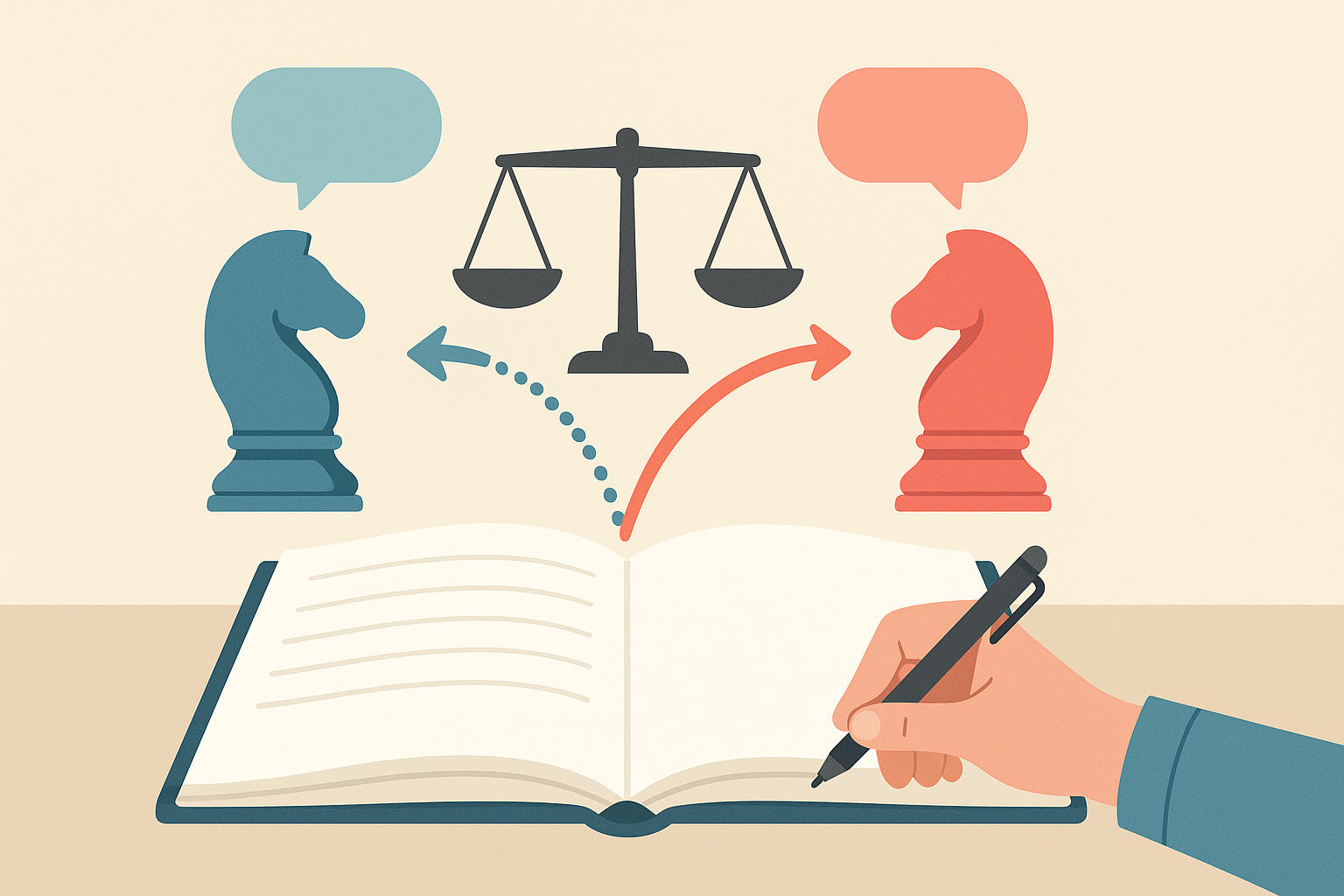
Counterargument & Rebuttal. Dedicate focused space to a strong opposing view, then respond with superior reasoning or evidence. Avoid strawmanning; steelman the best objection and answer it.
Conclusion. Do more than restate the thesis. Synthesize what your argument changes about the reader’s understanding, specify practical implications (policy, study design, study skills), and indicate limitations alongside a prudent next step.
A compact table can keep your draft on track:
| Section | Purpose | Include | Typical Length |
|---|---|---|---|
| Introduction | Frame the problem and state the thesis | Context, clear claim, roadmap | 10–15% |
| Background/Framework | Define constructs and lens | Key terms, core theory, scope | 15–20% |
| Body (Claims) | Argue with evidence | Study context, result, interpretation, limit | 45–55% |
| Counterargument & Rebuttal | Address the strongest objection | Steelman, evidence, response | 10–15% |
| Conclusion | Synthesize and project implications | What changes, practical step, limitation | 10–15% |
Use cohesive devices to keep the flow smooth: repetition with variation (“notification frequency… this frequency”), metadiscourse (“by contrast,” “therefore”), and theme-rheme progression (start sentences with known information, end with new). When changing scale—individual to population, lab to field—signal it clearly.
Writing Techniques that Raise Your Grade
Deep analysis over summary. Don’t repeat what a study did; explain why its method convinces (or fails to). If a study uses random assignment, highlight causal strength. If it relies on self-report, note susceptibility to demand characteristics or recall bias. Show how operational definitions shape results: measuring “attention” via continuous performance tasks is not the same as classroom engagement.
Causal reasoning with humility. Strong verbs like “causes” are rare in psychology without experimental leverage. Prefer calibrated language—“predicts,” “is associated with,” “likely contributes to”—unless the design justifies stronger claims. Hedging is not weakness; it’s disciplinary accuracy.
Counterargument strategy. Bring objections to the foreground. If arguing for notification caps, acknowledge autonomy and the educational benefits of connectedness. Then show net benefit via sleep architecture data and academic outcomes. Consider moderators (e.g., part-time students, neurodivergent learners) and specify targeted policies rather than blanket bans.
Style and readability. Psychology favors plain, direct prose. Prefer active constructions (“The intervention reduced distraction”) but maintain objectivity. Eliminate weasel words (“clearly,” “undoubtedly”) and overgeneralizations. Keep paragraphs focused; vary sentence length to avoid monotony while preserving clarity.
APA essentials (practical reminders). Use a clear title page if required, 12-pt readable font, double spacing, and one-inch margins. Headings should mirror your structure. In-text citations and a reference list are part of academic integrity; ensure consistency in author-date formatting and capitalization rules for titles. For statistics, report effect sizes and confidence intervals when available; round consistently and define abbreviations on first use. Tables and figures should add value—if a table repeats the text, cut it.
Editing pass. Read once for argument logic (do claims build?), once for evidence clarity (are methods and measures clear?), and once for style (concision, transitions, grammar). If possible, reverse-outline: extract your topic sentences and see if they alone form a coherent mini-argument. Where they don’t, revise.
Example Topics, Thesis Starters, and a Mini Case
To make the guidance tangible, here are focused topic ideas and thesis starters that embody operational clarity and argumentative strength:
1) Adolescent social media notifications and sleep.
Thesis starter: Limiting nightly notification frequency for first-year undergraduates reduces sleep fragmentation and next-day cognitive failures compared with unrestricted settings, even after controlling for baseline anxiety.
2) Cognitive-behavioral interventions for test anxiety.
Thesis starter: Brief CBT skills integrated into first-year seminars lower test anxiety and improve working-memory-dependent performance more than mindfulness-only workshops.
3) AI writing tools and academic integrity.
Thesis starter: Transparent AI-assisted drafting with mandatory process logs promotes learning outcomes without increasing plagiarism rates, outperforming prohibition policies that shift misconduct off-platform.
4) Video-game play and attentional control.
Thesis starter: Action video-game training enhances selective attention on lab tasks but shows limited transfer to real-classroom note-taking unless combined with metacognitive instruction.
5) Body image and social comparison.
Thesis starter: Exposure to idealized images predicts body dissatisfaction primarily via upward social comparison; teaching comparison reframing moderates the effect among late adolescents.
6) Growth mindset programs in STEM.
Thesis starter: Short, domain-specific growth-mindset prompts increase persistence in introductory STEM courses, but only when accompanied by formative feedback that specifies strategy, not just effort.
7) Smartphone bans in classrooms.
Thesis starter: Contextual smartphone restrictions during lectures improve quiz performance in large courses, though inclusive exceptions are necessary for students using assistive technologies.
8) Sleep hygiene education vs. schedule restructuring.
Thesis starter: Schedule restructuring (later class start times) yields larger gains in sleep duration and attention than hygiene-only education, indicating structural factors outweigh knowledge gaps.
To see the pieces working together, consider this mini case in condensed essay form.
Mini case: Should universities cap nighttime notifications for first-year students?
Introduction (problem & thesis). The transition to university often coincides with fragmented sleep and dips in executive function. Because attention and memory consolidate during sleep, interruptions from push notifications can create next-day cognitive costs. Universities should set default caps on nighttime notifications for first-year students because notification frequency, more than total screen time, disrupts sleep continuity and impairs academic performance, while still allowing students to opt in to critical alerts.
- Background (framework). From a cognitive perspective, notification chimes act as salient external cues that trigger orienting responses; even brief awakenings can fracture sleep cycles. Developmentally, first-year students are still calibrating self-regulation in novel environments; defaults matter because choice architecture nudges behavior without eroding autonomy.
- Body claim 1 (mechanism). Rapid-onset notifications prompt micro-arousals that increase sleep fragmentation, reducing deep sleep stages crucial for memory consolidation. Studies that compare quiet-mode nights with ordinary nights typically find next-day decrements in sustained attention tasks, suggesting a mechanistic pathway from nighttime salience → arousal → impaired attention.
- Body claim 2 (learning outcome). Fragmented sleep predicts working-memory load errors and slower processing speed—two abilities essential for lectures and exams. When first-year cohorts adopt reduced-notification defaults, follow-up assessments often show modest but reliable improvements in quiz accuracy and note quality, even when total screen time remains similar.
- Counterargument & rebuttal. Some argue that notifications support social connectedness and campus safety. Defaults can respect those aims: critical alerts remain permitted, while optional social notifications queue silently until morning. Opt-out options preserve autonomy. In sensitivity analyses, benefits remain for students with high baseline FOMO, suggesting the policy helps most without harming the rest.
- Conclusion (implications). Defaults that cap nighttime notifications appear to deliver low-cost academic gains while modeling healthy digital habits. Future work can test personalized schedules tied to chronotypes and incorporate equity checks to ensure accessibility. The broader lesson: arguments that treat mechanism and context together are more persuasive—and more useful.
Putting it all together in your draft. Start with a thesis framed by a psychological mechanism. Build paragraphs around claims that matter, not around sources. Use evidence strategically, show ethical awareness, and answer the best objection head-on. Edit until your logic is visible from the first sentence of each paragraph.
Related posts:
It is easy to check materials for uniqueness using our high-quality anti-plagiarism service.
Order now »