Table of contents
To write strong essays without all-nighters as a working student, build a repeatable system: plan backward from the due date, protect short writing windows around your shifts, draft from a tight outline, and revise in timed passes. Use micro-deadlines, simple templates, and energy-aware scheduling to finish early—without burning out.
Why All-Nighters Fail Working Students
All-nighters punish tomorrow to rescue today. When you work and study, that trade is brutal: the shift still starts at 7 a.m., your commute doesn’t vanish, and the next class still expects you awake. Sleep debt erodes memory consolidation, weakens argument logic, and invites formatting and citation mistakes you won’t catch.
The second failure is the myth of “one heroic session.” Complex writing is not carpentry you finish in a single afternoon. Good essays need incubation: ideas grow when you step away, return, and see what’s missing. A working student’s secret advantage is structure—short, planned bursts that stack into a finished draft with less stress.
Finally, all-nighters create a planning blind spot. When everything is “tonight,” you skip steps: unclear thesis, shallow evidence, no counterargument, no polish. The result isn’t just weaker; it’s slower, because you backtrack under pressure. A simple, repeatable playbook beats a desperate sprint.
Quick Comparison: All-Nighter vs. Playbook
| Aspect | All-Nighter Approach | Playbook Approach |
|---|---|---|
| Deadline risk | High (last-minute) | Low (buffered micro-deadlines) |
| Idea quality | Narrow, rushed | Broader, incubated across days |
| Energy & focus | Crashes next day | Pacing matches real energy peaks |
| Research depth | Skimmed sources | Targeted evidence captured early |
| Revision time | Minimal or none | Planned structural and style passes |
| Confidence | Anxiety spikes | Steady progress and control |
The Working Student Playbook (A Repeatable System)
This system respects your job schedule and your brain’s energy curve. You’ll write in small, protected windows, each with a single purpose. The steps are simple, but the timing is disciplined.
Step 1 — Backward-plan from the due date (10 minutes)
Start with the due date and create micro-deadlines two to four days apart: Outline → Research capture → Fast draft → Revise → Proof & submit. Place each micro-deadline at least 24 hours before a heavy shift. If your week is packed, shrink tasks rather than moving them; a 25-minute “micro” beats a 0-minute “perfect” block.
Step 2 — Lock a thesis and a micro-outline (20–30 minutes)
Your thesis is a defensible claim, not a topic. Write one sentence that clearly takes a side, then create a micro-outline:
-
Introduction: context in two lines + thesis.
-
Body 1–3: claim → evidence → why the evidence matters.
-
Counterargument & rebuttal: the best objection + your answer.
-
Conclusion: what changes if your thesis is true.
Keep the outline skeletal. Example thesis: Campus jobs, when scheduled under 15 hours weekly, improve academic performance by building time discipline and reducing financial stress. If you can’t name your two strongest pieces of evidence in plain language, pause and refine the thesis before you draft.
Step 3 — Research capture in two short bursts (40–60 minutes total)
Use two timed bursts to gather evidence that directly proves your claims. In Burst 1 (20–30 minutes), pull three high-quality sources and copy key quotes/statistics into a note with full citation details. In Burst 2 (20–30 minutes), add context you’ll need for rebuttal. Label each note: Claim, Evidence, So what? That last label forces interpretation, not just collection.
Pro tip: If a shift leaves you drained, swap Burst 2 with a lighter task (like formatting the title page) and do the second burst after sleep. Protect momentum; never end a day with zero progress.
Step 4 — Fast draft from the template (60–90 minutes)
Draft fast, edit slow. Paste your outline at the top of your document and expand, section by section, without stopping to polish. Aim for clear topic sentences: “Working fewer than 15 hours per week increases students’ adherence to study schedules.” Immediately follow with evidence and the “so what” sentence that ties back to your thesis. Add a short counterargument near the end and answer it directly.
Don’t obsess over phrasing; aim for completeness. Tag weak spots with bracketed notes like [find better stat], then keep moving. A complete ugly draft beats a beautiful fragment.
Step 5 — Revise in three focused passes (45–75 minutes total)
Make each pass do one job so your brain knows what to look for.
Pass A: Structure (15–25 minutes).
Verify the thesis appears early and echoes in each body paragraph. Check paragraph order: strongest point first or second. Ensure the counterargument is real, not a strawman, and that the rebuttal directly addresses it.
Pass B: Clarity & flow (20–30 minutes).
Cut throat-clearing phrases (“in my opinion,” “it is important to note that”). Replace vague verbs with active ones. Merge short, choppy sentences into smoother ones where meaning improves. Read the first and last sentence of each paragraph back-to-back; they should show a clear thread.
Pass C: Polish (10–20 minutes).
Handle formatting, citations, page numbers, and small grammar fixes. Trim repetition and tighten the conclusion so it answers “So what?” in fresh words, not a copy of the thesis.
Step 6 — Pre-submit checks and a short cooling break (15–30 minutes)
Give yourself a cooling break—even 30 minutes—before the final read-through. Then confirm: the file name is correct, requirements are met, citations are consistent, and the submission portal accepts your format. Submit with at least a 2–4 hour buffer, especially if you’ll be at work near the deadline.
The rhythm is simple: outline early, capture evidence, draft fast, revise in passes, submit with buffer. Repeat this pattern each assignment; it becomes muscle memory.
Tools, Templates, and Two Smart Lists
Don’t chase fancy apps; chase reliability. The best tools are the ones you’ll actually use after a long shift.
Timers and pacing. A basic smartphone timer is enough. Work in 25-minute focus blocks followed by 5-minute breaks. If you’ve just finished a late shift, start with a 15-minute “starter block” to lower the barrier. Momentum matters more than duration.
Micro-deadlines on one page. Keep your micro-deadlines on a single sheet—paper or digital. At the top, write the due date; below it, list your five milestones with dates and a checkbox. This page becomes your compass. When a supervisor asks you to pick up an extra hour, you can see instantly what to move.
A simple drafting template. Start new essays from the same skeleton so you never face a blank page:
-
Title (working): clear and specific.
-
Thesis (1 sentence).
-
Body Paragraphs (3–4): Topic sentence → Evidence → Explanation.
-
Counterargument + Rebuttal (1 paragraph).
-
Conclusion (1 paragraph).
Reuse this structure across subjects. The details change; the engine stays the same.
Energy-aware scheduling. Think in peaks, plateaus, and pits. Put heavy thinking (thesis, outlining) in your peaks (often mornings or post-nap). Put lighter tasks (formatting, references) in plateaus. Put admin tasks (file naming, upload checks) in pits. This way you never ask your 11 p.m. brain to invent a thesis from scratch.
Two-window writing day. For many working students, the winning pattern is one short block before work (15–30 minutes) and one medium block after (30–60 minutes). The first block sets direction; the second builds volume. On days off, add one longer block early and protect the evening for rest.
Submission-Week Checklist (print this page and tick boxes)
-
Confirm the due date and submission portal; write both on your micro-deadline sheet.
-
Schedule five milestones: Outline, Research, Draft, Revise, Proof/Submit—with calendar alerts.
-
Create or update your working title and one-sentence thesis.
-
Gather at least three quality sources; capture quotes with page numbers.
-
Draft body paragraphs first; add the introduction after the first body is done.
-
Insert one real counterargument and write a direct rebuttal.
-
Run three passes: Structure → Clarity & flow → Polish & formatting.
-
Check citations and reference list; make styles consistent.
-
Rename the file correctly and export to the required format.
-
Submit with a 2–4 hour buffer; confirm the upload by opening the submitted file preview.
If you only manage five of these items, do the first five. That combination alone prevents the last-minute spiral that leads to all-nighters.
Mini-Case Study: Shift, Study, Submit
Meet Maya, a commuter student who works 24 hours a week at a grocery store. She has an argumentative essay due Sunday at 11:59 p.m. Her shifts are Tue 3–9 p.m., Wed 7 a.m.–3 p.m., Fri 1–9 p.m., Sat 9 a.m.–5 p.m. Here’s how she applies the playbook without losing sleep.
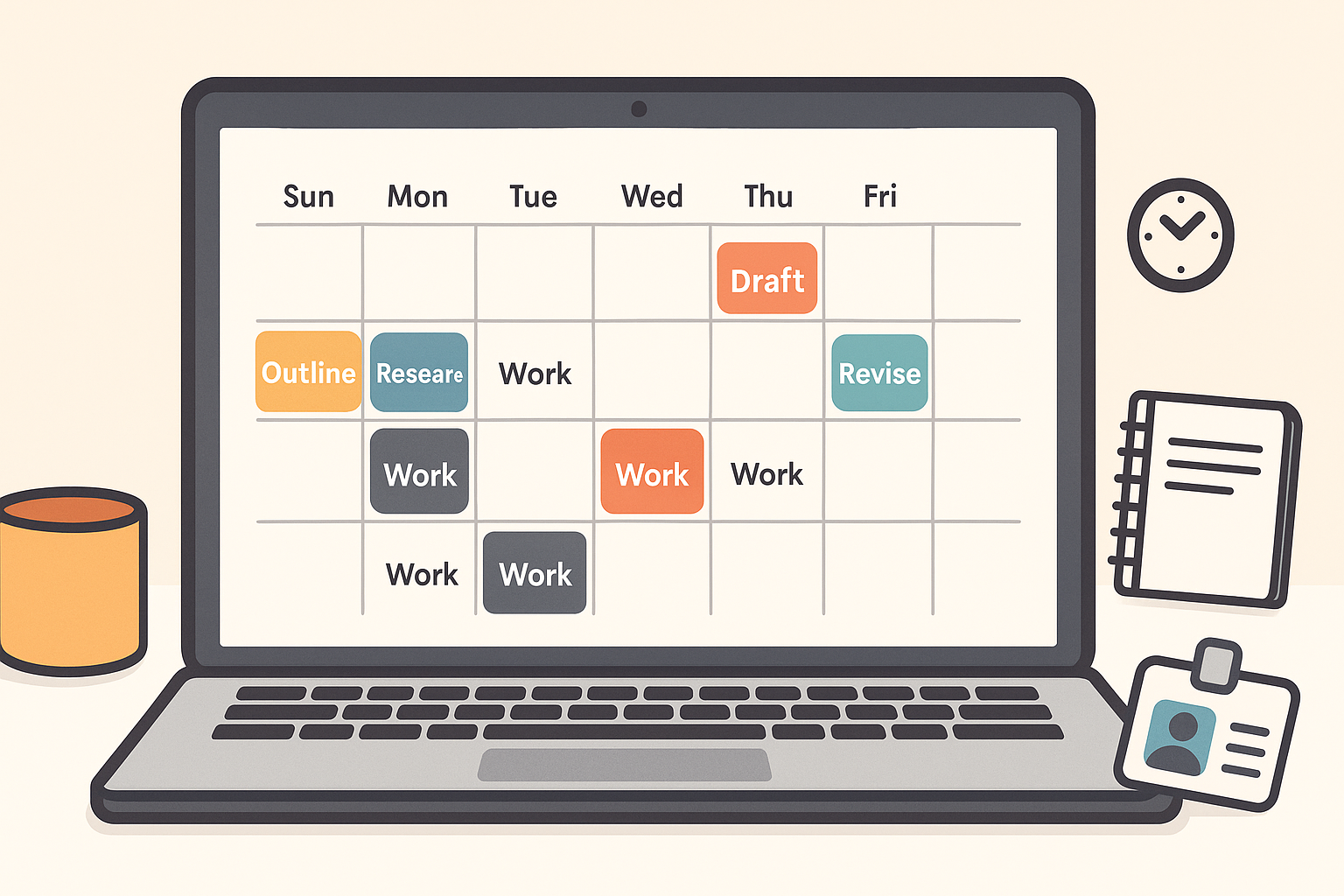
Sunday (one week out): Maya backward-plans. She places her milestones: Outline (Mon), Research capture (Tue–Wed), Draft (Thu), Revise (Sat morning), Proof & submit (Sun afternoon). She writes these on a single index card and sets five calendar alerts. The whole setup takes 10 minutes and immediately calms her because the path is visible.
Monday: She spends just 25 minutes before class creating a micro-outline and thesis: Local public transit discounts for student workers pay for themselves by reducing campus parking strain and supporting student retention. She sketches three body paragraphs: (1) cost offsets through lower parking demand, (2) improved on-time attendance for student workers, (3) retention data from peer cities. She ends the day with a clear map, not a blank page.
Tuesday: After a short commute, she runs Research Burst 1 for 25 minutes at the library: she collects two city reports and a campus memo, adds one key statistic to each body paragraph, and tags a note [counterargument: budget pressure]. She clocks in for her 3–9 p.m. shift. Post-shift, she’s tired, so she only formats the title page for 10 minutes. That keeps momentum alive.
Wednesday: Maya works 7 a.m.–3 p.m., so she uses a pre-work 20-minute window for Research Burst 2: a think-tank brief about transit funding. She writes a two-sentence counterargument: “Critics argue that discounts widen the budget gap without proof of academic benefit.” Then she drafts a rebuttal: “Existing commuter campuses show retention gains that offset revenue loss within two semesters.” After work, she’s done for the day—no guilt, because she hit the micro-deadline.
Thursday: Draft day. She sits for 45 minutes before lunch and converts her outline into 900 words. She inserts the counterargument near the end and answers it with the retention data. She flags two spots [need citation details] and [better transition]. In the evening she adds 30 more minutes, reaching 1,200 words. She doesn’t chase perfect sentences; she chases a complete draft.
Friday: Work 1–9 p.m. Before the shift, she runs Pass A (Structure) for 20 minutes, moving the strongest paragraph to the front and tightening topic sentences. After work, instead of cramming, she goes to bed. No all-nighter.
Saturday: Morning light equals energy. She does Pass B (Clarity & flow) for 25 minutes: trims filler, sharpens verbs, smooths transitions. In the afternoon, she prints the essay and reads it aloud once, marking five minor tweaks.
Sunday: She completes Pass C (Polish) in 15 minutes—citations, title formatting, page numbers—then takes a 45-minute cooling break and returns for a final skim. She submits at 5:45 p.m., more than six hours early, and opens the submission preview to confirm the file looks right. Total writing time: about 3 hours, spread across the week. Total sleep lost: zero.
Why this works: Maya never relies on one “perfect” session. Small wins compound, and each micro-deadline matches her schedule reality. By Monday, she already had a thesis and an outline. By Thursday, a complete draft. By Sunday, clean polish and a calm submission.
It is easy to check materials for uniqueness using our high-quality anti-plagiarism service.
Order now »